
How to Heal a Bulging Disc Naturally
A bulging disc is one of the most common reasons people experience persistent lower back pain, stiffness, and sciatic nerve pain. Many people searching for bulging disc treatment or lasting back pain relief are told to follow a familiar plan — strengthen the core, stretch regularly, rest when it hurts, and manage symptoms.
For some, this brings short-term relief. For many, the pain keeps returning.
The issue isn’t that a bulging disc can’t heal. The issue is that most approaches never change the conditions that caused the disc to stay irritated in the first place.
At Functional Patterns, bulging discs are approached as a movement and load-distribution problem, not just a spinal injury.
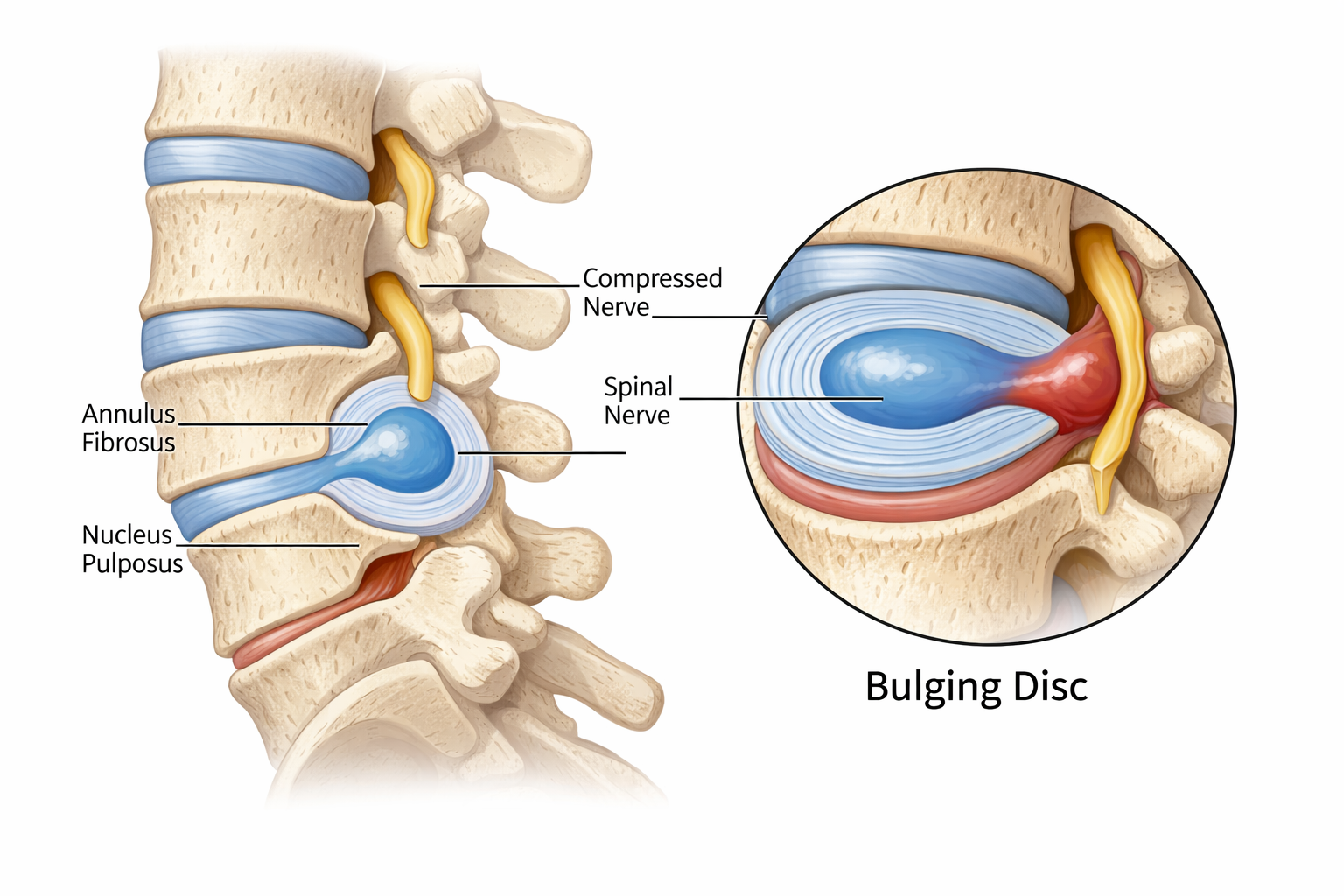
Can a Bulging Disc Heal Naturally?
In many cases, yes — a bulging disc can heal naturally.
Natural healing doesn’t happen just because pain settles or time passes. A disc bulge improves when the way force moves through the body changes. When chronic compression reduces and load is shared more evenly, the disc is no longer under constant stress.
Research consistently shows that:
Disc bulges are common in people with no pain
Bulging disc symptoms often involve nervous system sensitivity
Imaging findings don’t reliably predict symptoms
Understanding how to heal a bulging disc naturally means focusing less on the disc itself and more on how the body moves around it.
What a Bulging Disc Really Is
A disc bulge is a change in disc shape under repeated load. This most often occurs in the bulging disc lower back, where posture, prolonged sitting, and inefficient walking mechanics place ongoing pressure on the spine.
A bulging disc is typically:
Stress-related rather than injury-based
Influenced by how load is absorbed during movement
Capable of improving when conditions change
It isn’t a structural failure that automatically leads to surgery or lifelong pain.
Pain tends to appear when the spine is forced to compensate for inefficient movement elsewhere in the body.
Why Most Bulging Disc Treatments Don’t Last
Most bulging disc therapy treatments focus on where pain is felt, not on why stress keeps returning to the same area.
This often includes:
Isolated core strengthening exercises
Stretching already unstable spinal segments
Passive treatments aimed at short-term relief
Rest without retraining movement
While approaches like physio, massage, or spinal decompression may reduce pain temporarily, the disc is reloaded as soon as normal movement resumes. Without changing gait, rotation, and load transfer, symptoms often return.
The Missing Piece: Gait, Rotation, and Load Transfer

The spine doesn’t work in isolation. Every step you take transfers force from the ground through your body:
feet → legs → pelvis → spine → shoulders
If one side absorbs more force, rotates poorly, or collapses under fatigue, the spine compensates. Over time, this creates chronic compression and shear forces that irritate the disc and surrounding nerves.
This is why sciatic nerve pain and disc symptoms often persist even in people who feel strong or active.
Strength alone doesn’t protect the spine — how that strength is coordinated does.
Why Rest, Stretching, and Core Work Often Backfire
Rest can reduce symptoms, but it doesn’t restore resilience. Once activity resumes, the same loading patterns return.
Stretching unstable areas may feel helpful short term, but it can increase irritation when the spine lacks control.
Traditional core strengthening exercises often rely on bracing and stiffness. While this can feel supportive, it increases spinal compression and disconnects the core from natural walking and rotation.
Effective core function should help distribute force, not trap it in the spine.
What Natural Healing Actually Requires
Natural healing of a bulging disc happens when the body relearns how to move efficiently under load.
This means:
Reducing chronic spinal compression
Improving left–right symmetry
Restoring pelvic and thoracic rotation
Allowing the hips and legs to absorb force
Rather than avoiding movement, the spine needs better movement, progressively introduced in positions that reduce stress.
The Functional Patterns Approach to Bulging Disc Pain
Functional Patterns addresses bulging disc pain by changing the movement patterns that overload the spine — especially during walking.

The process focuses on:
Assessing and correcting gait
Restoring rotational mechanics
Using closed-chain loading strategies
Reintegrating the hips, spine, and shoulders
Instead of isolated disc exercises, clients learn how to move in a way that reduces spinal stress during real-life activity. When force is no longer concentrated through the lower back, the disc is given space to adapt naturally.
This is why results tend to be lasting rather than temporary.
What to Avoid If You Have a Bulging Disc
If you’re dealing with a bulging disc lower back issue, avoid approaches that:
Chase pain relief without mechanical change
Over-stretch the lumbar spine
Rely heavily on spinal flexion or twisting early on
Ignore walking mechanics
Pain relief without movement change rarely lasts.
How Long Does Natural Healing Take?
There’s no fixed timeline for bulging disc healing. Recovery depends on how long the disc has been overloaded and how ingrained movement patterns are.
That said, many people notice meaningful improvement within weeks once load is redistributed and compression reduces.
When Is Surgery Necessary?
Bulging disc surgery is rarely required. It’s generally considered only when there is:
Progressive neurological weakness
Loss of bowel or bladder control
Severe symptoms that don’t respond to conservative care
For most people, surgery doesn’t address why the disc became overloaded in the first place.
Final Thought
A bulging disc is rarely the root problem — it’s the signal.
Long-term bulging disc treatment comes from changing how your body moves, not chasing short-term back pain relief.
If you want to know how to heal a bulging disc naturally, start with movement, not fear.